« Blogs & Insights

Leading with purpose: culture at the core of sustainable leadership

Céline Chabée | May 20, 2026

In today’s life sciences and healthcare environment, leadership is evolving beyond technical expertise and operational execution. As organisations navigate complexity, transformation and increasing expectations, the focus is shifting toward culture, adaptability and long-term impact. Understanding how leaders approach these challenges provides valuable insight into what sustainable leadership requires today.

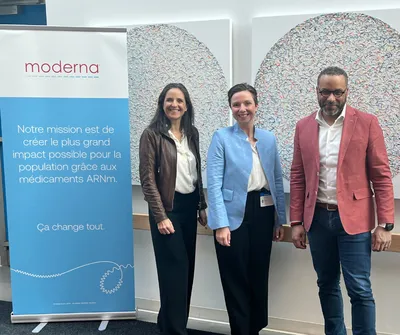
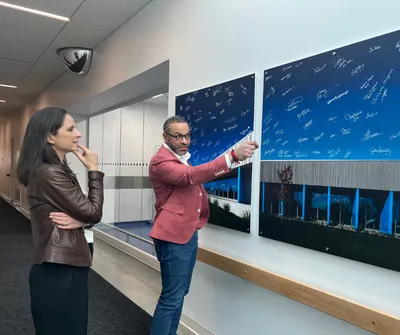
Céline Chabée, Partner at Kestria Canada & USA, interviewed Roger-Ketcha Ngassam, Manufacturing Site Head at Moderna, to explore his remarkable career and his perspective on building teams, shaping culture and leading through transformation in times of uncertainty. As part of this exchange, Céline and Tania Balassanian visited the Moderna Canada site to experience firsthand what he and his teams have built, reflecting Pender & Howe’s commitment to highlighting the journeys and perspectives of leaders shaping the life sciences and healthcare industry.

Joining Moderna: purpose and motivation 

What led you to join Moderna? And beyond the role itself, what did you feel you were coming to build?

For me, there were two fundamental elements. After working internationally for several years, I wanted to have an impact at home in Canada; I wanted to build and contribute to something bigger—here in Quebec.

At the same time, Moderna was embarking on an important journey to establish a manufacturing presence in Canada, strengthening local capabilities and resilience in biomanufacturing.

So when the opportunity arose, it wasn’t simply about building a new facility for Moderna—it’s never just bricks and mortar. It was about helping to anchor a transformative technology here: internalising capabilities, knowledge and expertise with immense potential.

Because the potential of the mRNA platform, in my view, is still far from fully realized.

At its core, leadership begins well before there is a facility to operate—it begins when there is nothing yet to run, only something to build. For me, that was the essence: contributing to something foundational, at home.

Building the team 

Concretely, what did that look like on the ground for you as a leader? And when it came to building the team, what really mattered?

When I arrived in mid-2023, there were two of us on site. We were still working out of construction trailers. Between February 2023 and February 2024, we built the facility in one year, to the day. But beyond the physical construction, the real challenge was people.

People would say: ‘You have five people on site and you want to produce a vaccine—how are you going to do that?’

The reality is that when we opened the first roles—10 positions—we received over 300 applications from highly qualified candidates around the world. There was a remarkable diversity of profiles.

Technical expertise was a given — but mindset set us apart. I wasn’t chosen for deep mRNA specialization, but to help build a team where that expertise could come together and deliver.

I was chosen for my background in biopharmaceutical manufacturing, with mRNA a newer modality for me — highlighting our focus on assembling diverse, complementary expertise.

What we were looking for was:
• Curiosity
• Humility
• A sense of purpose and alignment with the meaning behind our work.

In a new environment, where many things are being built that don’t yet exist, expertise alone isn’t enough. 

It is the combination of strong capabilities and the right mindset that allows teams to adapt, learn quickly and navigate challenges together. When people are aligned around a “why,” they can overcome challenges together.

From building to sustaining 

At some point, building gives way to something else. When did you feel the shift between “moving things forward” (the building phase) and “making things last”? What changed for you?

The shift this year was from a project mindset to an operational one. During construction, we were driven by aggressive milestones and timelines. We worked intensely, but at a certain point, it became clear that this pace wasn’t sustainable. The biggest learning for me has been the importance of managing energy over the long term.

We then had to introduce more structure:
• Systems
• Processes
• Overall balance

The real turning point in leadership is when you move from producing results to building a system that consistently delivers them. I had to adjust my approach and adapt to situations that can vary.

I see myself as a shepherd: sometimes in front, sometimes behind, sometimes in the middle. At times, you need to give direction, and others, you need to protect the team.
Defining sustainable leadership 

This brings us to the heart of the topic: sustainable leadership. How do you define it, concretely?

For me, sustainable leadership is first and foremost about culture, because culture remains even when leadership changes.

People often say, “We’re going to change the culture”. But culture isn’t something you change—it’s something that develops. It is the result of actions.

Culture is not a statement—it is a living system that structures performance over time.

Operations can evolve, but culture must endure.

Leadership in action: building culture in everyday moments 

What you describe feels very tangible. Can you share a concrete moment that illustrates this leadership?

Yes—a very simple example.
After an official event—a moment that seemed trivial, almost mundane—we had to wash the dishes. We didn’t yet have all the facilities in place, so it simply had to be done.

I found myself at the sink, cleaning. Next to me was one of the most senior federal ministers, speaking with me very naturally. To me, that moment says a lot.

Because I didn’t ask someone else to do it, and I didn’t step away either—I did it. And the teams see that. They see that, regardless of the role we hold, we are part of the collective and that no task is beneath us.

That’s what I want to embody. Because, in the end, culture isn’t built in big presentations—it’s built in moments like these.

For me, that’s alignment: when what you say and what you do are perfectly aligned, even in the simplest things.

Leadership is not declared—it is seen in the simplest actions.

Adaptive leadership in practice 

You often speak about this “shepherd” style of leadership. How do you find the balance between stepping back and stepping in?

It’s very situational. Fundamentally, I see myself as being in the middle of the team.

For example, every three weeks, we hold what we call “shared moments.” We gather—bagels, coffee. These are not town halls. I’m not a fan of town halls—they tend to be top-down. Here, we share.

Effective leadership is not positional—it is relational and contextual.

I also made a mistake: I stopped these moments. We saw a drop in engagement, and the teams told me. So I reinstated them, because that connection is essential.

Energy and resilience 

Sustaining leadership also means sustaining yourself. How do you manage your energy?

I draw my energy from the teams. When things get difficult, I go back to the field.
I talk to people, and problems return to a more manageable scale. There is also a lot of feedback, sometimes critical.

A leader’s energy doesn’t come from control, but from connection.

But that requires authenticity: admitting, “I’m not perfect—help me improve.” Otherwise, you create distance.

Building for the future: leadership and legacy 

When you project yourself into the future, what does it mean for you to build something bigger than yourself?

It means building something that will last.

Today, we are focused on developing a centre of excellence here, with global impact—while also contributing to the broader ecosystem:
• Universities
• Conferences
• Panels

A leader’s success is not what they build—it is what continues to exist without them.

For me, it all comes back to the original idea: showing what Canada is capable of.

About Moderna

Moderna is a pioneer and leader in the field of mRNA medicine. Through the advancement of its technology platform, Moderna is reimagining how medicines are made to transform how we treat and prevent diseases. Since its founding, Moderna's mRNA platform has enabled the development of vaccines and therapeutics across infectious diseases, cancer, rare diseases, and more.

With a global team and a unique culture, driven by the company's values and mindsets, Moderna's mission is to deliver the greatest possible impact to people through mRNA medicines.

Blogs & Insights